
Kent County Bench Warrants Explained
Kent County publishes no local definition, list, or step-by-step process for a bench warrant. The phrase describes what happens after a person skips a required appearance or ignores a court order. The exact name of the process and the fix depend on which court entered the order in your case. A missed traffic setting might sit with the JP or Jayton Municipal Court. A missed district setting belongs to the 39th District Court. A fine judgment raises a different animal, the capias pro fine, which carries its own statutory notice, hardship, and recall rules. So the first question is not what the warrant is called. It is which court entered the order and what that order demands.
Kent County JP Bench Warrant Routing
Kent County has one countywide Justice of the Peace. That office, held by David L. Parker, is the first call for any JP traffic, Class C, or fine matter. The official directory lists the JP's phone and email, nothing more. There is no public citation search, capias list, online payment page, or posted warrant-hours schedule. When you call, ask whether your matter is still just a citation, whether a capias or other process has issued, and what amount or appearance is still owed. Ask too whether the court offers a recall step or a payment plan. If you cannot tell which office issued the process, the Kent County sheriff's main number can route your inquiry. The OCA court directory names the countywide JP contact.
Kent County Justice of the Peace
P.O. Box 462, Jayton, TX 79528
(806) 237-3646
How Kent County Bench Warrants Are Issued
A court or a magistrate issues this process under whatever law fits the case. For justice and municipal courts, that law is Chapter 45A, which covers both arrest warrants and capias pro fine. Kent County publishes no grace period, no warning letter, and no local setting code that runs before a warrant issues. Once the process goes out, the court keeps the case-side record. A peace officer may receive it for service. Do not assume a state database or the sheriff's page shows every lower-court case in Kent County. Ask the court directly what order was entered and whether a new setting is open to you. The Texas Chapter 45A text sets out the justice and municipal court rules.
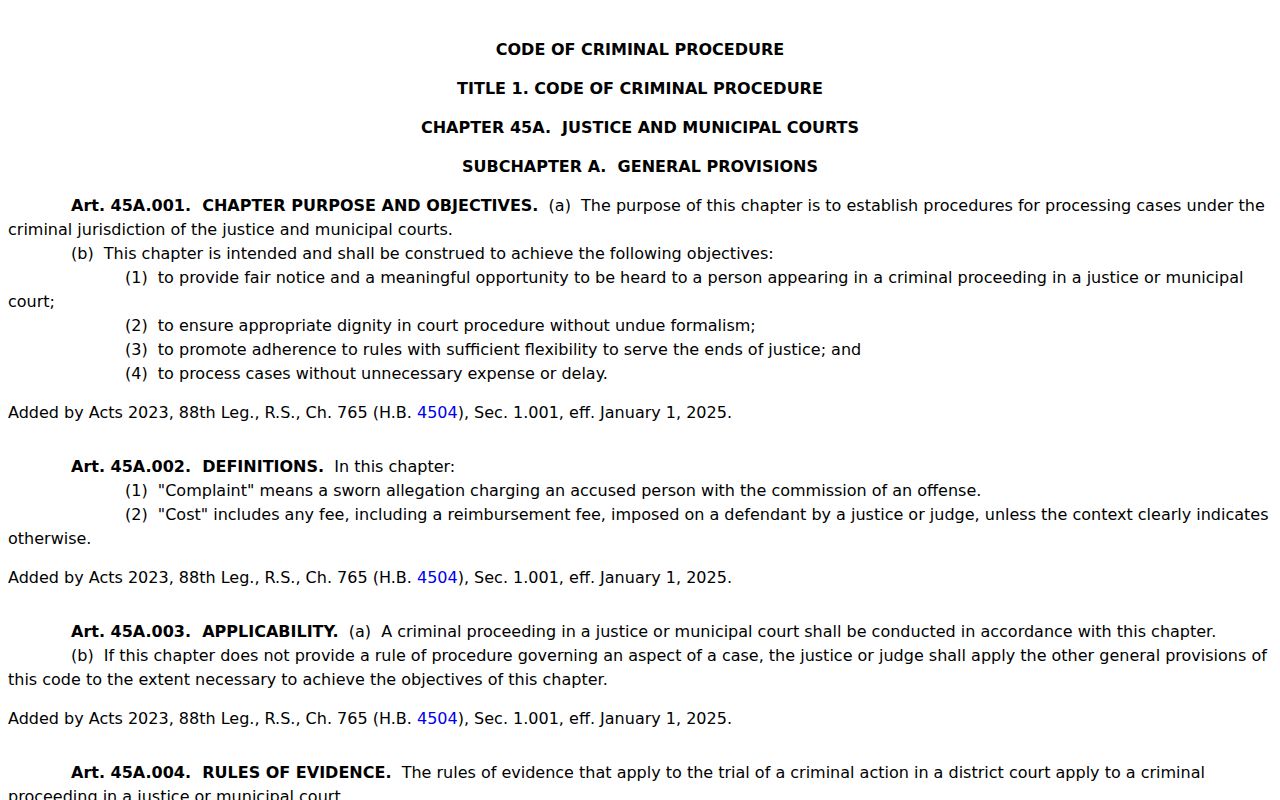
The statute image is statewide law, not proof of a separate Kent local rule.
Kent County's Four-County Warrant Route
The 39th District Court serves four counties: Kent, Haskell, Stonewall, and Throckmorton. Its judge and coordinator work out of Haskell. Kent County's District & County Clerk sits in Jayton and keeps the district-side case file. A missed district setting can therefore take two calls, one to the court and one to the clerk. The clerk explains how to reach a case record. The judge controls any judicial relief. The public directory confirms the combined clerk arrangement but shows no active bench-warrant list and no walk-through schedule. The Texas court personnel directory lists the district and county contacts.
Bench Warrants and Arrest Warrants Compared
A bench warrant ties to a court obligation in a case already open. An arrest warrant authorizes custody on probable cause for an offense. The two processes run on different tracks in Kent County. See the Kent County arrest-warrant information for that separate process.
| Question | Bench process | Arrest warrant |
|---|---|---|
| Common trigger | Missed appearance or noncompliance | Sworn complaint or affidavit and probable cause |
| Case connection | Often an existing court matter | Criminal process for an alleged offense |
| Who controls relief | Court that set the obligation | Issuing court or magistrate |
| Local detail | No Kent list or recall form located | No Kent public search or bond schedule located |
Kent County Capias Pro Fine Is Separate
A capias pro fine comes after a judgment. It enforces a fine or court costs through court process. It is not a catch-all name for every missed date. Chapter 45A builds in an undue-hardship process and allows recall when a person voluntarily appears or gives notice and a hearing gets set. The court that entered the judgment must explain the amount owed and the options in the case, whether a payment plan, community service, jail credit, or recall. Kent County publishes no local capias form and no payment portal. Never assume a partial payment clears the process either. The TMCEC 2026 bench book index is official statewide court education material.
The bench book provides general context; the issuing Kent court controls a case-specific decision.
Resolving a Kent County Bench Warrant
Pin down the court and the underlying obligation before you appear anywhere. Call the issuing court and the sheriff for routing, then ask which path fits: a scheduled appearance, an attorney-arranged walk-through, a bond, a payment plan, or a motion to recall or quash. Kent County posts no walk-in policy, jail address, bond window, or accepted payment method.
- Use the citation or case paper to identify the court and case number.
- Ask whether process is active and what obligation remains.
- Discuss an appearance, recall motion, payment option, or bond with the court and counsel.
- Get a written receipt or order and ask when the court will update the sheriff or DPS.
Caution: Do not arrive without instructions. Ask the court what will happen after an appearance and whether counsel can arrange a walk-through.
Kent County Missed-Court Warrant Steps
If a notice says you missed court, call the court printed on that notice first. Ask whether the case is still a citation, whether a warrant or capias issued, and whether the next step is a reset, a hearing, or another order. A DPS license hold is not itself proof of an arrest warrant. Family-enforcement matters work differently. Those go to the court with continuing jurisdiction, and Family Code Chapter 157 carries its own enforcement and bond rules. Kent County lists no local family-court portal or support-enforcement desk. Read the Texas Family Code Chapter 157 for the separate enforcement framework.
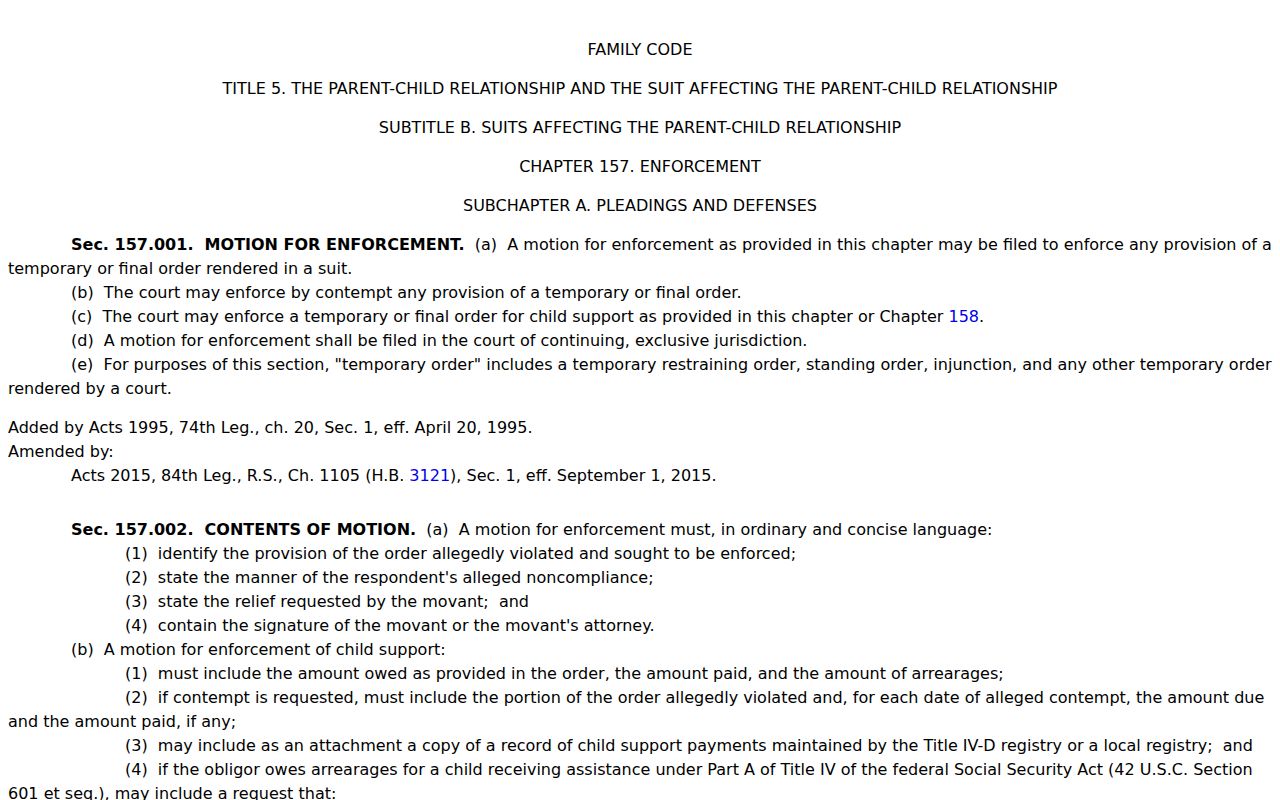
Family enforcement runs on its own process. Kent County treats it nothing like a JP traffic case.
Call Before Any Kent County Warrant Appearance
Phone first. Kent County's combined District & County Clerk sits at P.O. Box 9, Jayton, and the 39th District Court coordinator takes calls at (940) 864-2661. The countywide justice of the peace is listed separately at (806) 237-3646. A call is for learning the rules, not for clearing anything, since no Kent County office promises a surrender or a bond set over the phone. So ask the questions that matter. What identification or papers does the court want? Can a lawyer appear for you, and could showing up mean custody? Kent County's public sources say nothing about same-day processing, a local recall fee, or how long an update takes. For paperwork, the official TMCEC forms-book index lists statewide forms and warrant topics.
The forms index is a statewide reference only, and no Kent County court is bound by it; ask the court clerk which form it accepts before any Kent County warrant appearance.
Finding the Court That Issued the Warrant
Start with the paper that opened the case. A Kent County felony belongs to the 39th District Court, filed through the district side of the combined clerk. County-level cases go to County Court. Traffic and Class C matters land in the countywide justice court. Jayton runs its own municipal process, and it lists no public court contact. If the paperwork leaves you unsure, the sheriff at 227 S. Main Street, Jayton, can point you to the right agency at (806) 237-3801. Whatever office you reach, ask for its own record and its instructions for recalling the warrant. The county overview of Kent County warrant routes describes each local office and where public access stops.
Kent County Bench Process Has Limits
Some Kent County records stay closed. Juvenile matters, active investigations, and sealed search-warrant affidavits may all be withheld from the public. Child arrest-warrant information and its supporting papers carry specific protection under Family Code §58.010. The Texas juvenile-record statute spells out that confidentiality rule and its exceptions, and a clerk may review a request before releasing anything.